

Showing posts with label Apple. Show all posts
Showing posts with label Apple. Show all posts

Feb 15, 2015
Apple’s iPhone Overtakes Android In US Sales For The First Time Since 2012

Apple, in its flush of new, bigger iPhone 6 handsets, has been selling record numbers of its older and newer model smartphones in the last few months, and now it’s passed another significant milestone: it has managed to overtake sales of Android devices in the key market of the U.S. for the first time in three years.
Feb 5, 2015
Android vs. Apple: Can’t we all just get along?

Jan 30, 2015

Jan 18, 2015
Why Is Apple Going To Have A Better Time Launching A Wearable?
Why Is Apple Going To Have A Better Time Launching A Wearable?
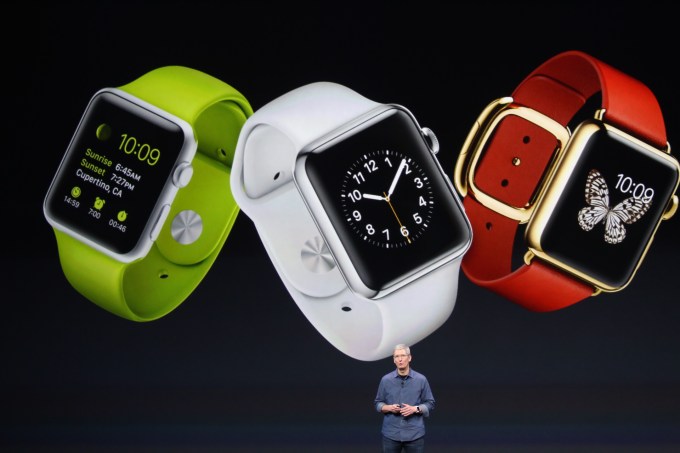
At some point in the next few months (“Early 2015″ can’t push much past March, can it?), Apple will release its Watch, likely defining the high end of the wearable category.
The Apple Watch is, in hindsight, exactly what Apple would make when entering a new category: a general purpose computer trimmed down to the essentials needed for its particular form factor. It shares its industrial design with its bigger cousins in your pocket, likely shares the same underlying UNIX operating system, and starting this year will even have its own native apps.
Analysts think that it’s going to sell somewhere in the range of 30 million units in its first 12 months — nowhere close to the range of the iPhone or iPad today but still incredibly impressive for the wearable category overall.
Analyst predictions of Apple sales can always be taken with a grain of salt, but especially so in the wearables category, where no one really knows anything yet anyway.
We only bother looking at analyst predictions because they are a reflection of broader expectations for how the Apple Watch will do. Despite launching well after Android Wear and Samsung’s very early attempts at making smart watches, consumers and Wall Street alike seem to be looking at the Apple Watch to set the tone for the wearables market in the same way that the iPhone and iPad did for smartphones and tablets, respectively.
Why the expected success, in the face of competition whose devices offer roughly the same functions?
If you take a look through the Watch Kit Apple released to developers back in November, the apps iOS developers can make for the Watch today are not far off from what’s available on the Android side of things. At launch, there’s going to be a lot of actionable notifications and functions that work in unison with apps on your phone.
So why does everyone think the Apple Watch is going to do so well compared to the current slate of smart watches available on the market?
First, there is a matter of momentum. Apple has spent a lot of time capturing a market, teaching them the benefits of their ecosystem and locking them in. A certain segment of those people will buy the Apple Watch regardless of what it may or may not do for them.
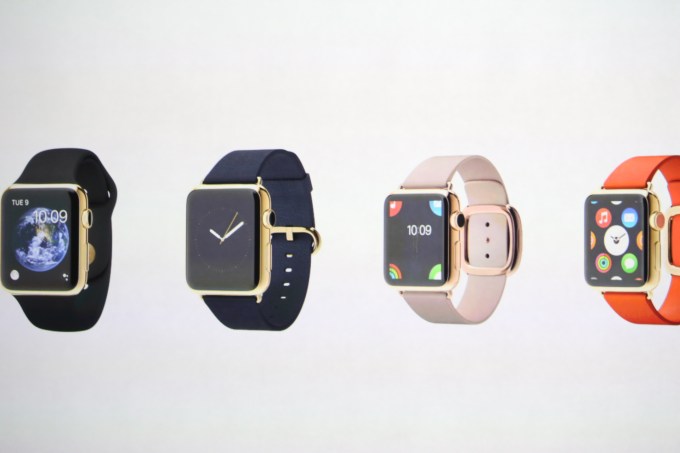
Millions of people will buy the Apple Watch because just owning it will seem cool.
Independent analyst Neil Cybart captures that rather well in this blog post. Basically, people will project their own reasons to be interested in the Apple Watch:
Over the past few months, I’ve learned to change the way I explain Apple Watch to friends and family. Instead of starting out with a list of reasons why they may enjoy an Apple Watch, I now begin with a pretty simply explanation: Apple is making a watch with customizable faces and bands. I then let that person respond, and depending on their answer, I mention how Apple Watch can serve as a communication device, a health and fitness tracker, or a mobile payment facilitator. As a result, I now get a much more open response from people that want to see and learn more about Apple Watch. That is how Apple will sell Apple Watch.
Going beyond that simple assumption, Apple is the best in the business at creating narratives around the products they sell. Of course, Google did a fine job of bringing in developers to come up with use cases for Android Wear when it debuted at Google I/O: “Too drunk to order a Lyft from your phone? Yell at your wrist instead!”
In fact, there was quite a bit of overlap in functionality between what Google showed off with partners on that day and the apps Apple presented on stage last September.
But Apple has proven with every “new” product category introduction that it knows which features a lot of people will need to justify a purchase. With the iPhone, it was a phone, iPod, and internet device. With the iPad, it had made a powerful computer that could handle productivity software but also provided a better book-reading/movie-watching experiencethan any single-user device before it.
Even though several Android manufacturers beat Apple to market with tablets between the iPhone and iPad launches, Apple thrashed (and continues to dominate) the category in profitability. That ownership (regardless of its long-term future) started with filling basic needs that would make their devices compelling.
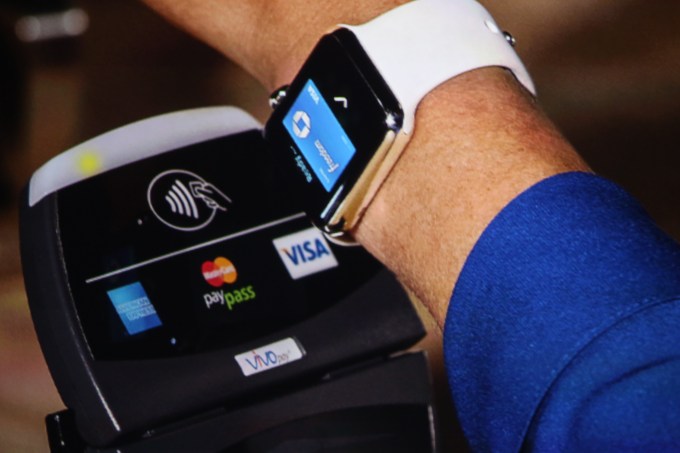
The Apple Watch opens up Apple Pay to those without the latest iPhones.
There’s reason to believe that Apple will do the same when it officially launches its Watch. TechCrunch has heard from several sources that Apple has brought in developers of apps that “obviously” need to be on the platform.
Companies like Facebook, Twitter, and Pinterest are being courted in order to make sure their apps are up to snuff for launch. We’ve also heard that Apple has been reaching out to smaller developers it likes, requesting video demos of apps running in the Apple Watch simulator. Some of these will likely end up as key part’s of Apple’s narrative just as Pixelmator wasfeatured so prominently in the debut of the new iPad Air 2, setting the tone for Apple’s new ads.
All of that is to say Apple will have a reason ready for consumers to buy their fancy new watches as soon as they’re made: a decent suite of launch apps.
From there, its success is essentially limited by whether or not it’s cool enough to significantly expand the size of the smart watch market. As Creative Strategies analyst Ben Bajarin wrote last week, there are two obvious outcomes for the Apple Watch: it either completely owns the space like its spiritual successor, the iPod, or it dominates the high-end of the market while bringing in a rather small portion of market share, losing out to cheaper Android Wear devices and fitness trackers going for much less.
Why isn’t there a third option, where the Apple Watch is a total dud? Well, that’s still a possibility if the wearable category as a whole is something that every company thinks is a good idea but really no one wants. I don’t think that’s the case.
In addition to the advantages above, Apple also has the fact that it will probably be the only viable truly premium option in town. It’s going to have a solid-freaking-gold option, for goodness’ sake.
As blogger Matt Richman wrote last week, there’s no way Apple will open up the functionality that will make the Apple Watch so attractive (the connection to the iPhone at the operating system level) to anything but its own Watch. Actual luxury-watch makers will have to rely on Android Wear if they want to compete, which will only work with Android phones… which wealthy people, as a category, don’t buy. If there’s even a bit of a smart watch market, Apple will assuredly take the high end of it.
Jan 17, 2015
Google Wants To Own Mobile Wallet
The big phone carriers might sell Google their mobile wallet

Remember Softcard (formerly Isis, but renamed for obvious reasons)? It's a joint venture that AT&T, Verizon and T-Mobile started in 2010 to get into mobile payments without ceding the market to Google Wallet and Apple Pay. That hasn't quite worked out, since few want to put a $70 case on their iPhone to use mobile payments, and a caselessoption for the iPhone 6 has yet to arrive. Tonight Techcrunch first reported rumors that it's in talks for a sale to Google, while Paypal and Microsoft are apparently interested too. The initial report puts its pricetag at under $100 million, less than the hundreds of millions the mobile carriers invested in it. Google and Softcard have both declined to comment on the rumor, but it seems more a matter of when and who will pick up the pieces, not if.
SOURCE: Techcrunch
Feb 10, 2014
Steve Jobs wanted Sony VAIOs to run Mac's operating system
Steve Jobs wanted Sony VAIOs to run Mac's operating system

If Steve Jobs had gotten his way, that VAIO in your lap could've been running OS X, Apple's operating system. It sounds like fiction, but consider the source: former Sony president Kunitake Ando. The revelation, which stems from an interview Ando gave to Japanese journalist Nobuyuki Hayashi in 2011, highlights the close relationship Jobs reportedly shared with Sony's co-founder Akio Morita -- a relationship that led Jobs to make an exception to Apple's walled off ecosystem. And according to Ando, it was on a 2001 golf trip in Hawaii that Jobs decided to surprise Sony executives with a version of Mac OS X running on a VAIO, four years before the Intel transition was made public.
As we all now know, that Apple/Sony partnership wasn't meant to be. For Sony, the proposal was simply a case of bad timing, as it ran counter to not only the success the VAIO line was experiencing at the time, but also the wishes of its engineering team. After having spent so much time optimizing VAIO for Windows, Ando says Sony's engineering team saw OS X on VAIO as a diversion of resources and were "opposed [to] asking 'if it is worth it'." It was because of these two factors that Sony never pursued the prospect of Mac-compatible VAIOs any further.
While we'll never know the impact Mac-compatible VAIOs would've had on Sony's bottomline today, the news does come at an odd time for the struggling Japanese tech giant. Recently, its VAIO PC division's been surrounded by rumors of a possible sale; rumors Sony isn't exactly dismissing as inaccurate. And with Sony now looking to home entertainment and gaming as two key areas for growth, that potential sale seems right in line with the company's current strategy.
Feb 7, 2014


You have to hold iPad Air to believe it. It’s just 7.5 millimetres thin and weighs less than half a kilo. The stunning Retina display sits inside thinner bezels, so all you see is your content. And an incredible amount of power lies inside the sleek enclosure. So you can do so much more. With so much less.


The new A7 chip in iPad Air was designed with 64-bit architecture. It delivers killer performance — up to two times faster CPU and graphics performance than its predecessor — without sacrificing battery life. So you get incredible power in a device you can take with you wherever you go.


iPad Air keeps you connected faster than ever. In more locations than ever. Using two antennas instead of one and MIMO technology, iPad Air delivers up to twice the Wi‑Fi performance of its predecessor. And the Wi‑Fi + Cellular model supports more networks than ever, so you can make quick, easy connections the world over.2


iPad apps are like no other. Because they’re designed just for iPad, they look amazing and use every pixel of the beautiful display. iPad Air comes with great built-in apps for the everyday things you do, like checking email and surfing the web. To help you be even more creative and productive, iPhoto, iMovie, GarageBand, Pages, Numbers and Keynote are now available for free. And over 475,000 other incredible iPad apps are just a tap away in the App Store.3 With apps like these, iPad Air can do just about anything — which means you can too.


iOS 7 was designed to take advantage of 64-bit architecture. So it’s every bit as advanced as the iPad Air it runs on. And with new features like smarter multitasking, Control Centre and AirDrop, iOS 7 makes the experience of using iPad Air even more beautiful and simple. Because iOS 7 and iPad Air weren’t just designed to work together, they were designed to enhance one another.


The redesigned Smart Cover and Smart Case are a perfect fit for iPad Air. They automatically wake it when opened and put it to sleep when closed. They also fold to create a great stand for reading, viewing and typing. And they come in a whole range of colours. So they don’t just work smart, they look smart.4

Steve Wozniak thinks Apple should build an Android smartphone
Steve Wozniak thinks Apple should build an Android smartphone

Yes, folks, this is real life. In an interview with Wired, at the Apps World North America conference, Steve Wozniak revealed his belief that Apple should create a phone using Google's Android operating system. According to him, "There's nothing that would keep Apple out of the Android market as a secondary phone market ... We could play in two arenas at the same time." As Wired's Mat Honan notes, the idea of such a handset wouldn't be technically impossible, but anyone who's familiar with the Apple of today knows that the chances of this actually happening are slim to none.
"We [Apple] could compete very well. People like the precious looks of stylings and manufacturing that we do in our product compared to the other Android offerings," Wozniak stated during the interview. Of course, this isn't the first time(and very likely won't be the last) in which the great, legendary Woz has spoken openly about his thoughts on Apple- and Android-related affairs -- still, it's always interesting to hear his perspective on the tech industry. Wozniak also spoke toWired about the film Her, Moore's Law and even why he thinks the Cupertino company has yet to release a smartwatch or TV. You can check out the full interview right here.
Apple looking to hire fitness physiologists
Apple looking to hire fitness physiologists

Apple is reportedly inviting job applications for the position of "User Studies Exercise Physiologist" amid speculations of a possible launch of potential iWatch, riddled with biometric sensors.
While the company's CEO Tim Cook seems to have acknowledged the 'wearable' product, the move is being seen as Apple's attempt to enter the health and fitness product market. According to the Tech Crunch, Apple is seeking a suitable candidate who will be in charge of creating and conducting studies related to cardiovascular fitness & energy expenditure, including calories burned, metabolic rate, aerobic fitness level measurement/tracking.
The candidate will be required to gather and research this kind of data and apply relevant knowledge to the design of products and their testing/validation through user studies. Meanwhile, Apple has listed its new job amid reports from 9to5Mac about Apple hiring a sleep research expert and another report from the website about Apple working on a new dedicated health app called "Healthbook", which could probably be included in its next major iOS iteration.
While the company's CEO Tim Cook seems to have acknowledged the 'wearable' product, the move is being seen as Apple's attempt to enter the health and fitness product market. According to the Tech Crunch, Apple is seeking a suitable candidate who will be in charge of creating and conducting studies related to cardiovascular fitness & energy expenditure, including calories burned, metabolic rate, aerobic fitness level measurement/tracking.
The candidate will be required to gather and research this kind of data and apply relevant knowledge to the design of products and their testing/validation through user studies. Meanwhile, Apple has listed its new job amid reports from 9to5Mac about Apple hiring a sleep research expert and another report from the website about Apple working on a new dedicated health app called "Healthbook", which could probably be included in its next major iOS iteration.
Feb 5, 2014
Apple and Samsung's Next Trial
Apple and Samsung to spar over iPhone 5, Galaxy Note II at next trial

Perpetual court combatants Apple and Samsung have revealed their final list of allegations ahead of a trial starting March 31st. Though each started with five disputed patents, Samsung only has four now since a multimedia sync patent was knocked out earlier by Judge Lucy Koh. She also gave Apple a summary judgement win on its auto-complete IP, putting it ahead before the trial even begins. As for the rest, it's worth noting that all of Apple's patents are related to user interaction, while two of Samsung's are standards-essential (FRAND) patents -- which companies are normally obligated to license out. Samsung did have one point in its favor, however: the USPTO has agreed to take a second look at the validity of Apple's aforementioned auto-complete patent.
As for the devices accused of infringing those patents, none are very recent models and many aren't even on the market anymore. However, the historical sales of each will affect the size of any award given by the court if an allegation is upheld. That's a lot of infringement for ultra-popular models like the Galaxy Note II, Galaxy S III, iPhone 5 and iPhone 4s, which have far out sold disputed models from the previous trial (like Samsung's original Galaxy S). Other names on the list include the Galaxy Nexus and Galaxy Tab 2 10.1 from Samsung, along with Apple's iPad 2, iPad with Retina display (3rd-gen), iPad with Retina display (4th-gen) and iPad Mini (the original, without a Retina display). Of course, there's always the upcoming negotiations between company CEOs to avoid all that, but... nah, who are we kidding.
Apple gushes on 30 years of making Macs
Apple gushes on 30 years of making Macs

This year signifies the 30th anniversary of the Macintosh computer, and who better to reflect on this achievement than the almighty creator Apple? Cupertino has dedicated a corner of its website to such a retrospective, the focal point of which is an inspirational video starring several fans who talk about what Macs have meant to them (embedded below). After learning that Moby is still a thing and that Macs represent a "truly worldwide democratization of creativity," you can peruse a slick, interactive timeline that walks you through all the iterations and how innovative each one was. You can also tell Apple about your first Mac and what you used it for, with that data populating polls around the site. There areworse ways to kill time, so if you've got some to spare, head to the source link and bathe in Cook & Co's glory -- then head on over to our forum to wax poeticabout your first Mac.
Apple and carriers will donate free devices and broadband to US schools
Apple and carriers will donate free devices and broadband to US schools

The White House won't be going it alone as it brings US classrooms into the internet era through its ConnectED initiative -- it just revealed that a host oftechnology firms will also lend a hand. Apple plans to donate $100 million in iPads, MacBooks and software to underprivileged schools, while Autodesk and O'Reilly Media will give away free software and content. Microsoft, in turn, will heavily discount Windows to lower educational PC prices. Carriers are getting in on the action, too. AT&T and Sprint have both pledged to offer free wireless broadband to schools for multiple years; Verizon isn't giving away service, but it will donate up to $100 million in cash and other commitments. The combined efforts aren't going to fix the American education system by themselves, but they could create a level playing field for schools across the country.
Subscribe to:
Posts (Atom)