

Showing posts with label smartphone. Show all posts
Showing posts with label smartphone. Show all posts
Mar 3, 2015


Feb 15, 2015
Apple’s iPhone Overtakes Android In US Sales For The First Time Since 2012

Apple, in its flush of new, bigger iPhone 6 handsets, has been selling record numbers of its older and newer model smartphones in the last few months, and now it’s passed another significant milestone: it has managed to overtake sales of Android devices in the key market of the U.S. for the first time in three years.
Feb 8, 2015
World's First Ubutnu Phone Wants To Shake Up The Home Screen

The BQ Aquaris E4.5 Ubuntu Edition will be the world's first Ubuntu Phone when it goes on sale in Europe on Monday 9 February, after years of false starts and broken promises.
Feb 5, 2015
Android vs. Apple: Can’t we all just get along?

Jan 26, 2015
10 Useful Android Tips And Tricks You Should Know

In this post, we are featuring 10 useful Android tips and tricks that may improve your experience while using your Android device. Do note that the steps may vary a little from one Android phone to another due to the differences in the build and the OS version, but if you play around with it, the next step isn’t too far off.
Jan 20, 2015
How to Unlock/Reset an Android Pattern Lock
 Android is a most popular smartphone operating system from Google. It has a lot of features for our day to day life. Android has taken care all of its features and makes this operating system best from every corner. When it comes to security, here also google added some great feature to keep a phone secure from unauthorized access. Pattern lock is one of the best security system by google.A Pattern lock consists of 9 dots and the user can set a particular pattern which should initially match to unlock the device.
How Xiaomi Keeps Cost of Its SmartPhones Low !!
This Is How Xiaomi Keeps The Cost Of Its Smartphones So Low
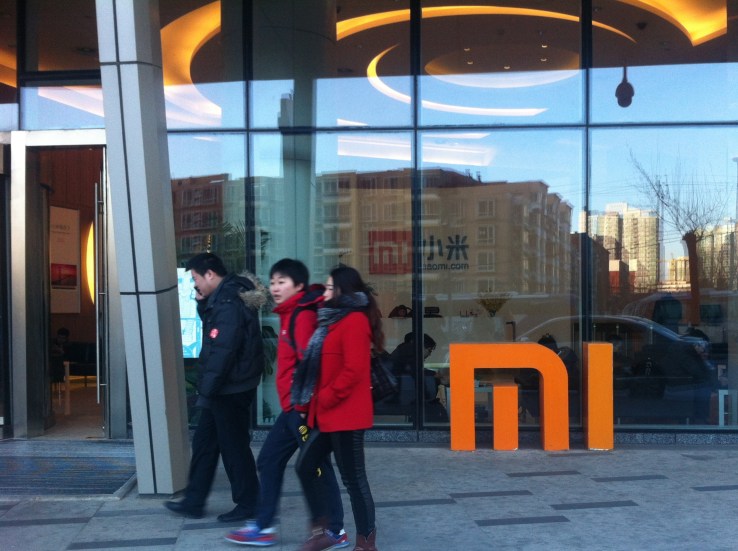
Xiaomi’s combination of well-spec’ed phones and low price tags drove the company to over 60 million sales last year. That progress saw it replace Samsung as China’s top-selling smartphone company and become the world’s third top selling phone maker in the process.
The Chinese company’s flagship Mi devices typically retail for around $300 — its new Mi Note Pro notably breaks the $500 barrier for the first time — while its affordable Redmi family is sub-$150. For comparison, Apple’s top of the range iPhones sell for over $1,000 off contract, while the Samsung Note and GalaxyS families are similarly priced. So how can Xiaomi be so aggressive with its pricing?
Many theories have been put forward, including claims that Xiaomi sells at cost and makes money from other services. Hugo Barra, the company’s VP of International, lifted the lid on some of the company’s secret sauce in an interview with TechCrunch in Beijing last week.
Xiaomi is able to make price concessions thanks to the combination of a small portfolio and longer average selling time per device
Barra explained that Xiaomi is able to make price concessions thanks to the combination of a small portfolio and longer average selling time per device.
Importantly, Xiaomi continues to sell older devices (and tweaked versions of them) at reduced prices even after it releases newer models.
“A product that stays on the shelf for 18-24 months — which is most of our products — goes through three or four price cuts. The Mi2 and Mi2s are essentially the same device, for example,” Barra explained. “The Mi2/Mi2s were on sale for 26 months. The Redmi 1 was first launched in September 2013, and we just announced the Redmi 2 this month, that’s 16 months later.”
That’s important because the longer runway for devices gives Xiaomi leverage to secure better component deals with its suppliers.
“The reason we do these price cuts is because we’ve managed to negotiate component cost decreases [with our suppliers] over time, which ends up leaving us with a bigger margin than we’d like to have, so we do a price cut,” Barra added.
“The vast majority of the components [in our devices] are still the same, so in terms of supply chain and component sourcing, we’re on the same supply contracts as Redmi 1, which means we’re still getting the same discounts on components,” he explained. “We can continue to ride the cost curve, so the importance of having a very small portfolio is significant — the fact that we only launch a few products each year, and (the fact that) we only have two product families.”
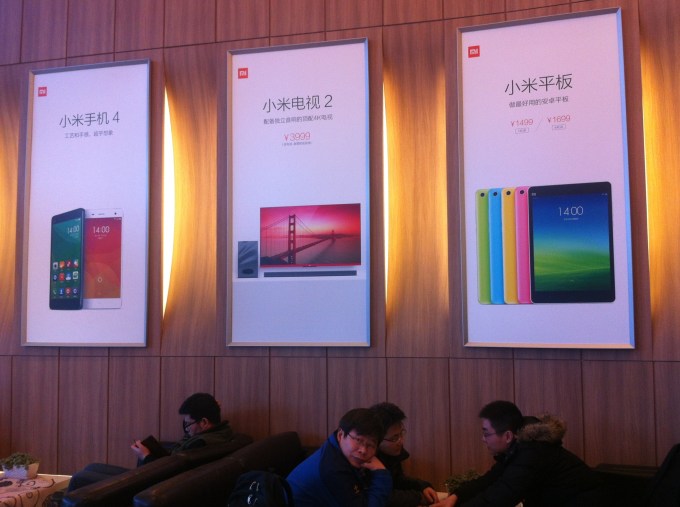
Barra said that the dynamics are “very simple,” but a commitment to devices for two or three years isn’t just about making price cuts. He pointed out that Xiaomi maintains software updates, spare parts and other services that customers require, longer than most companies would.
“The more focused the portfolio, the more efficient we can be at managing those costs too,” he explained.
There are other factors that contribute to the cost structure, including Xiaomi’s lean, online-only marketing focus and its location close to manufacturing plants in China , but the management of components and supply chain partnerships is a crucial element.
Xiaomi has big plans for expanding beyond Asia this year, which will make its pricing model and supply chain more important than ever.
The company sells its phone using an online-only model in most markets, but it has recently begun testing operator partnerships outside of China. It is running a limited trial with Airtel in India, and has found partners in Taiwan, Malaysia and Singapore.
Barra explained that operator partnerships are difficult in markets where the majority of consumers are on pre-paid tariffs — such as India — but it seems clear that Xiaomi is looking into ways to expand its retail footprint. It sold one million devices in its first five months in India using its flash sales model. If it can move beyond that and better meet demand for its phones in India and other emerging markets, it could vastly increase its sales figures in 2015.
Last year, Xiaomi projected that it would sell 100 million devices this year. It increased its target for 2014 mid-way through the year, but we’re yet to hear of a new figure for 2015 from the company
Jan 19, 2015
Get a new Samsung phone? Here are six things to turn off
Get a new Samsung phone? Here are six things to turn off
NEW SAMSUNG PHONES ARE GREAT, EXCEPT FOR THE PARTS THAT AREN'T
When it comes to the sheer number of features offered, Samsung's TouchWiz is pretty much unmatched. If you can imagine it, chances are it's a feature on the latest Samsung phones like the Galaxy S5, Galaxy Note 4 or Galaxy Alpha. Many of these features are useful, but there's some stuff enabled out of the box that you might want to selectively turn off.
Read on to see which six features we find ourselves killing off when we start using a new Samsung phone.

1. THE WATER DROPLET TOUCH SOUNDS
Bloop. Bloop. Bloop. Start up a new Samsung phone for the first time and these water droplet sounds will punctuate your every touch of the screen. A relic of the Galaxy S3's nature-inspired UI, this minor irritant can be disabled by toggling "Settings > Sound > Touch sounds" into the off position.

2. THE SAMSUNG WHISTLE
Even if you've never owned a Samsung phone, chances are you're familiar with the unmistakable piercing whistle of the company's default notification sound. You can change it to something less objectionable under "Settings > Sound > Notifications."

3. DOUBLE-TAP S VOICE SHORTCUT
Samsung's personal assistant has improved considerably since it first appeared on the Galaxy S3. But if you're not using it every day, you could make your home button more responsive by disabling the S Voice long-press shortcut.
First load S Voice, then hit the menu key (or three dots at the top of the screen) and select "Settings." From there, uncheck "Open via the home key." With this option disabled, the home key will respond immediately when pressed, rather than waiting to see if a second press is coming.

4. MY MAGAZINE ON YOUR HOME SCREEN
In the default TouchWiz launcher, swiping right from the leftmost home screen panel will load up "My Magazine," Samsung's Flipboard-powered home screen reader. If you're using it, great. If not, kill it by long-pressing on an empty home screen space, then tapping "Home screen settings" and unchecking "My Magazine."

5. LOCK SCREEN SOUNDS
If Samsung's spritely default screen unlock sounds are just too cheerful for your tastes, they're easily disabled under "Settings > Sound > Screen lock sound."
Jan 18, 2015
80% Of All Online Adults Now Own A Smartphone
80% Of All Online Adults Now Own A Smartphone, Less Than 10% Use Wearables
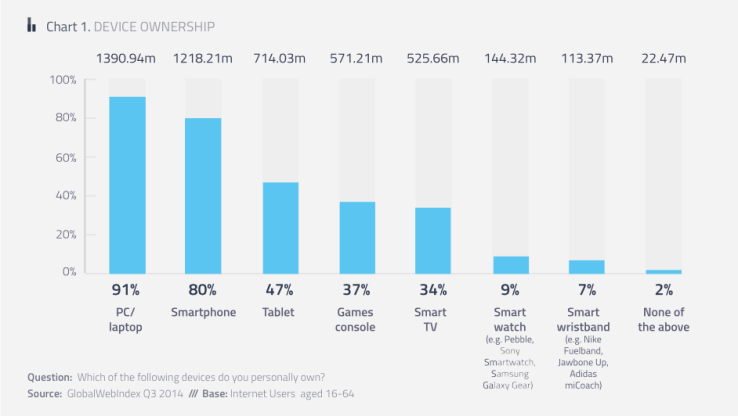
If people are looking to Apple and its new smartwatch to kickstart wider consumer interest in wearable computing gadgets, the maker of the iPhone will have a lot of work ahead of it.New research out from the GlobalWebIndex indicates that in a survey of 170,000 adult internet users across 32 markets, only 9% report having a smartwatch, and 7% said they owned smart wristbands. In contrast, among online adults, 80% now own a smartphone.
The proportion of smartphone ownership has reached a new high, but it has not yet overtaken legacy ownership and usage of PCs, which is currently at 91% of all online adults.
Some other interesting data points highlighted in GWI’s research:
– Wearables. Within the wearables category, the biggest number of device owners are affluent males in the 25-34 year-old group who reside in the Asia Pacific region. This points to these smaller, portable and more narrowly functional devices continuing their market placement as niche products that have yet to find a groove to appeal to a wider range of consumers.
– Platform ‘wars’ are over and Android won. Breaking out how different mobile platforms are performing in the smartphone and tablet sectors, it’s no surprise to see that Android is firmly ahead of iOS. What’s interesting to see, however, is just how far they have diverged and when.

We have heard various market analysts point out that Apple’s iPhone sales have seen a big bump in the wake of the launch of the iPhone 6 models, but it’s not clear that the ownership picture as depicted by GWI supports that.
While Android was creeping up quarter on quarter, the difference between Q2 and Q3 noticeably got flatter, which could indicate slowing sales, except that the iPhone numbers appeared to flatten/increase only very slightly.
In other words, if there has been an impact, it will have to be sustained by Apple to show any meaningful shift in ownership. As it stands now, Android’s 54% share represents a 38-point lead over iPhone/iOS, with the gap widening.
Back in 2011, the ratio of Android to iOS users was just under 2:1; in 2014, it has increased significantly to approach 3.5:1, GWI notes.
Whether that divergence will ultimately start to play out in where developers invest their time and efforts will be the really important question for users (and Apple).
– Tablets. In tablets, to me the most interesting point is a historical one: we like to talk about how Apple and the iPad dominate tablets, and while that may be the truth as far as the single brand is concerned, when it comes to platform dominance, Apple hasn’t been in a leadership position since Q4 2011, and really dropped away from a close position in 2013.
– Mobile internet use. GWI says that 75% percent of smartphone users are accessing mobile internet services on their smartphones — meaning a whole 25% are still not. The average amount of time that people are spending on their mobile devices is 1.85 hours/day, up by about 40 minutes on 2012. Because emerging market consumers often replace PCs with phones, they are using those phones the most, on average at more than three hours/day in the Middle East and Africa.
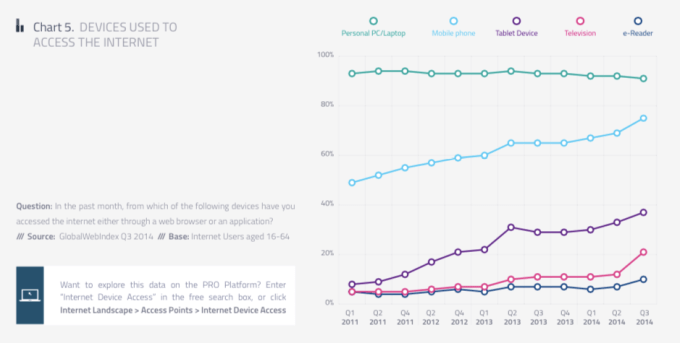
As you can see in the chart, mobile is used for Internet access far more than tablets, TVs and e-readers, but as with device ownership, it’s not yet passing PC/laptop usage, which is around 90%.
– VPNs, popular content. GWI also delves into what kinds of content is being consumed on the Internet access front, and how users are getting to it. The rising tide of restrictive firewalls in some markets has led to increased usage of VPNs to access the Internet. These VPNs effectively let you appear on the Internet as if you are somewhere that you are actually not. Currently, GWI says that some 27% of respondents, of 400 million users, say that they have used VPNs to go online, with China alone accounting for 150 million people.
Among those users, they are unsurprisingly significantly more avid online consumers of content than those not using VPNs. Google Play scored the highest of all services accessed by VPN and regular Internet users, who would be turning to the search giant’s store not for apps but for video and audio and gaming content.

Samsung's New 5.5-Inch Galaxy A7 Smartphone
Samsung Packs An 8-Core Processor Into Its New 5.5-Inch Galaxy A7 Smartphone

Last year Samsung released an eight-core version of the Galaxy S5, and now it has outed a dedicated octocore smartphone in its own right: the Galaxy A7.
Korean firm teased the phone in 2014 and showcased it last week, according to a report, but now it is official with dual 1.8GHz and 1.3GHz quad-core processors (or 1.5GHz and 1.0GHz in the dual-SIM version) and a 64-bit Qualcomm Snapdragon chip. Those eight cores are great for handling multiple tasks, on paper, and are backed up with 16GB of memorystorage, 2GB of RAM and a large 2,600mAh battery.
There’s no word on launch dates, initial markets or pricing, although reports last week pegged it at around $420 off contract.
The phone runs Android KitKat and sports a 5.5-inch screen, making it larger than the Galaxy A3 and Galaxy A7 that were announced back in October. Like those two products, it is another slim, metallic bodied release from Samsung, which has long been criticized for using all-plastic bodies, including faux leather.
Samsung has again focused on appealing to cameraphone enthusiasts. There is a 13-megapixel rear-facing camera and a 5-megapixel front-facing camera. On the software side, the Galaxy A7 software that Samsung claims can take a ‘wide’ selfie, while ‘auto selfie’ lets narcissists snap themselves using “a voice command or even a simple wave of the hand” –selfie sticks be damned.
Samsung is also touting ‘Always Clear Voice Auto Control’ which reduces background noise in-call, multiple screen support for apps and a private mode that “adds an extra layer of security for important files and documents.”
The introduction of the Galaxy A3, A5 and A7 over the past few months is interesting: Samsung is diversifying its focus beyond its flagship Galaxy S and Note families. The company is bracing itself for its first profit drop in three years, and its latest Galaxy S5 and Note 4 don’t appear to be selling as well as previous models.
The Galaxy A3 and A7 were pretty focused on China, as we noted last year, but Samsung is birthing a new series of phones that offer something else to consumers. With a distinctly different design, marketing focus and lower prices, the Galaxy A series looks to be its Xiaomi-like effort at bringing a quality experience to the mid-range of the smartphone market.
Feb 7, 2014
Steve Wozniak thinks Apple should build an Android smartphone
Steve Wozniak thinks Apple should build an Android smartphone

Yes, folks, this is real life. In an interview with Wired, at the Apps World North America conference, Steve Wozniak revealed his belief that Apple should create a phone using Google's Android operating system. According to him, "There's nothing that would keep Apple out of the Android market as a secondary phone market ... We could play in two arenas at the same time." As Wired's Mat Honan notes, the idea of such a handset wouldn't be technically impossible, but anyone who's familiar with the Apple of today knows that the chances of this actually happening are slim to none.
"We [Apple] could compete very well. People like the precious looks of stylings and manufacturing that we do in our product compared to the other Android offerings," Wozniak stated during the interview. Of course, this isn't the first time(and very likely won't be the last) in which the great, legendary Woz has spoken openly about his thoughts on Apple- and Android-related affairs -- still, it's always interesting to hear his perspective on the tech industry. Wozniak also spoke toWired about the film Her, Moore's Law and even why he thinks the Cupertino company has yet to release a smartwatch or TV. You can check out the full interview right here.
Feb 4, 2014
Sony experia Z1 Cpmpact
Sony Xperia Z1 Compact review: a good thing in a small(ish) package

Last year, Sony finally reached the end of the alphabet with its Xperia Z. It wasn't just that the company ran out of letters, though: With the Xperia Z, we saw Sony streamline its scattered phone strategy, piping all its attention into a single high-end device. Then, it followed up with the Z1, which brought a massive 20.7-megapixel camera.
Today, we once again have a new phone to talk about, except it's perhaps not the device you might have been expecting. Nope, this isn't a Z2, and no it doesn't bring an even higher-resolution camera. Instead, Sony's joining the small-flagship club, with the Xperia Z1 Compact. Interestingly, unlike some of its rivals, Sony is promising that you won't have to compromise on features for the sake of a more pocket-friendly handset. At £440 SIM-free in the UK, that apparently includes a no-compromise price, too. By the looks of it, though, Sony has worked hard to stick with the same specs as the original -- bar, of course, the screen size. So, is this finally proof that "mini" doesn't have to mean mediocre? We put it to the testto find out.


HARDWARE
At first glance the original Z1 and the Compact are nearly identical -- apart from the physical dimensions, of course. Look a little closer, however, and you'll spot a few small differences. For example, the Z1 Compact now has all the connections and ports on the left side, complete with the usual protective flaps. The microSDslot and micro-USB port sit up top, with the (micro) SIM slot hanging out on the bottom edge. (To jog your memory, the Xperia Z1's SIM port is over on the top-right edge.) Other differences: The headphone jack is ever so slightly farther inset on the top edge, and the camera flash now sits beside, not below, the lens. As you can see, we're already scraping around for significant differences. It's also worth noting that the build materials once again include glass and aluminum, so you won't have to suffer any plastic downgrade here (we're looking at you, HTC).
With the Compact, Sony stuck with its so-called OmniBalance design, which means for now, at least, it's passing on the chance to reimagine its phones. Instead, the company has been making subtle tweaks with each new device. And that's OK, too. After all, we've found little fault with the build quality and design on the Z and Z1, so why change it? As you can imagine, then, the Compact feels just as premium as the other Z-series phones, and possibly more so, given how dense it is. It's so dense, in fact, that at 137 grams, it's even heavier than some bigger flagships, like the Nexus 5.

Of course, this well-trodden design path brings many of the same trade-offs. Inour Z1 review, we noted that it was something of a fluff-magnet; every time you retrieved it from your pocket, it would bring with it a renewed collection of lint. Unfortunately, that's just as true of the Compact. It's impressive to see how efficiently it extracts the finest fibers from your pocket every time you remove it. If you ever need to take photos of this phone -- say, for a review -- you'll definitely need canned air, a lint-free cloth and an abundance of patience.
Another unfortunate carryover is the speaker placement, along the bottom edge of the phone. When we were testing the original Z1, we found that holding the phone in landscape to watch a movie meant one of your hands inevitably obscured the speaker, muffling the audio. Nothing has changed this time around, which means if you're watching something in landscape, you'll want to make sure you have some headphones on hand. Granted, this is a common location for the speaker, but for some reason -- perhaps the slight recess -- it's particularly noticeable on the Compact.
On a more positive note, Sony decided to break away from its normal black, white and purple color choices. The Compact does come in black and white, but also a zesty lime hue and a fairly wild pink option. Our review unit was the lime one (though it's a very yellowish lime), and we quite like how bold it is -- a treatment we hope Sony decides to keep giving its phones. Another nice touch is that the metal edges match, or complement, the body color. On the lime one, for example, the aluminum sections are a light gold, or "champagne" tone, and it definitely gives the overall design a coherent feel. Be warned, though, that after barely three days with the Compact, we noticed a small part of the champagne finish had chipped off, revealing the true metal color beneath.

As with the exterior design, talking about the Compact's specs is an exercise in repetition. It's like-for-like with the original Z1, for the most part. For those of you who don't keep track of such things (that's most of you, we'd hope), the two phones share a quad-core 2.2GHz Snapdragon 800 processor, a 20.7-megapixel camera (1/2.3-inch sensor) and 16GB of onboard storage (expandable by 64GB via microSD). Additionally, it packs 2GB of RAM, Bluetooth 4.0 (with aptX support), ANT+, GPS/GLONASS and NFC. Our global (D5503) model supports LTE Bands 1, 2, 3, 4, 5, 7, 8 and 20 -- this covers almost all European networks. While there's no word on a US release, it's compatible with T-Mobile and AT&T, and potentially some areas on Verizon too. There's a bevy of media options as well, with support for Miracast, DLNA and MHL. As has become a bit of a Sony trademark, the Compact is also IP58 waterproof and dust proof, meaning it'll happily take a dunk in a bath, toilet or drink. There's no wireless charging, though, which is a shame. As usual, the battery is locked inside, so you can't swap it out and pop in a spare.
The key things to note are that the display is now 4.3 inches in size with "only" 720p resolution (the Z1 measures five inches on the nose and boasts 1080p). That sees the pixel density drop slightly from 441 pixels per inch to around the 340-ppi mark, but that's still pretty decent. Similarly, the battery now has a capacity of 2,300mAh, down from 3,000mAh in the original. The positive spin there is that a smaller display sucks less juice, so in theory, it's a technical, not functional trade-off. Given that the main difference is the size, Sony's done a fine job of shoehorning all that technology into a smaller package. We already mentioned that the Compact definitely feels denser, but it's a smidge fatter too -- about one millimeter thicker.
If you're used to using a larger phone, the Compact might not initially feel as small as you'd expect, especially with the decent-sized bezel at the top and bottom. Overall, it's probably right to call this mid-sized, rather than small or mini. (In all fairness to Sony's marketing team, "compact" is a more appropriate word.) It actually has a similar footprint to the iPhone -- which is unsurprising, given that Sony is probably going after Apple customers here. In short, Sony's managed to create something that's very easy to use one-handed, without feeling particularly small or slight.
| SONY XPERIA Z1 COMPACT | |
|---|---|
| Dimensions | 127 x 64.9 x 9.5 mm |
| Weight | 137g |
| Screen size | 4.3 inches |
| Screen resolution | 1,280 x 720 |
| Screen type | Triluminos LCD with 16 million colors |
| Battery | 2,300mAh Li-ion (non-removable) |
| Internal storage | 16GB (12GB free) |
| External storage | microSDXC, up to 64GB |
| Rear camera | 20.7MP (1/2.3-inch sensor, f/2.0 lens with 27mm equiv. focal length) |
| Front-facing cam | 2MP stills, 1080p video |
| Video capture | 1080p |
| NFC | Yes |
| Radios | HSPA+ (850/900/1700/1900/2100); GSM GPRS/EDGE (850/900/1800/1900); LTE (Bands 1, 2, 3, 4, 5, 7, 8, 20) |
| Bluetooth | v4.0 |
| SoC | Qualcomm Snapdragon 800 (MSM8974) |
| CPU | 2.2GHz quad-core Krait 400 |
| GPU | Adreno 330 |
| RAM | 2GB |
| Entertainment | MHL, Miracast, WiFi Direct, DLNA |
| WiFi | Dual-band, 802.11a/ac/b/g/n |
| Wireless Charging | No |
| Operating system | Android 4.3 (Sony-specific UI) |
DISPLAY

We've already covered most of what you need to know about the display: It's 4.3 inches with 720p resolution. But, given that aspects of the displays in both the Xperia Z and Xperia Z1 have previously left us underwhelmed, it's clearly an area worth revisiting. Our primary concern until now has been the viewing angles. The Xperia Z, in particular, suffered from a terribly narrow viewing range, with the image soon fading away to unwatchable levels if you weren't standing directly in front of it. The situation didn't improve with the Z1.
At last, the Compact puts this issue to rest. The display is not only easily readable from a wider range of positions, but colors are vibrant without being oversaturated (take note, Samsung). This is no doubt thanks to Sony's X-Reality engine, which, according to the marketing, selectively processes everything you watch to make it as lifelike as possible. That might be so, but it also appears to add some slight pixelation to contrasting edges (think white text on a black background). There's also still room for improvement with the blacks, which continue to appear slightly faded. Overall, though, the display here is a clear improvement over its predecessors.
CAMERA

A good display is not much fun if you don't have anything exciting to view on it. That's partly where the camera comes in, and at 20.7 megapixels, this one's quite a doozy -- at least on paper. It's also the exact same Sony G Lens, 1/2.3-inch sensor with Exmor RS and BIONZ mobile image processing that we saw in the full-size Z1. Once again, there's a dedicated camera button, which also serves as a shortcut to the camera (via a long-press).
We wish there were something new to add here that we didn't go over last time. But alas, Sony's determination to make sure that you get the same experience evidently means you're getting, well, the full experience, and nothing more. At the very least, if you were a fan of Sony's homegrown camera app suite (that can provide image-based information, social sharing of your photos, etc.), you'll be glad to know it's still here in the Compact.


If you weren't interested in the Z1, then you'll definitely want a quick recap of the camera performance. Sony's claim is simple: The Z1 family sports one of the highest-resolution sensors on the market. The company's also thrown in a bunch of technology borrowed from its standalone cameras, including that BIONZ image processing. It even claims that the sensor here is the "equivalent" size to that used in the firm's Cyber-shot line, but that doesn't tell us much with so many other factors involved. The idea clearly was to have media, photos and video be a central feature. The reality is that it's not the best camera we've found in a phone (that would be the Nokia Lumia 1020's PureView cam), but it's certainly one of the more capable Android cameras we've come across. If we're determined to find it a "best" title, then it's the best camera we've seen on a Android phone.

So why is that? It comes down to a number of factors, not least of which is the pixel count. There's also, of course, the fast f/2.0 27mm-equivalent G lens. That wide aperture allows plenty of light to pour in, giving it consistently solid results, even when conditions are somewhat dim. It also provides a good depth of field, ideal for those who like a bit of "bokeh" -- that blend of sharpness on the subject, and out-of-focus background.
As for noise, the usual telltale sign of a cameraphone? When viewing images at 100 percent (quite a task at 20.7 megapixels) you'll find some artifacts, along with color washout in areas around the edge of your subject, or where the lighting contrasts with the metered area (e.g., if you have the metering mode set to central, the edges might suffer). All that said, this was a small detail we noticed while checking some of our sample shots for this review. What's more, smoother edges render quite well. Clouds are an abundant resource in London at this time of year, and we were actually impressed by how the textures and moody grays came out, really showing off the rich palette at the Compact's disposal.
Photographers will most likely be happy with the camera's "Superior Auto" mode, which generally delivers pleasing results: rich colors, good white balance and even exposure. If you're more of a tinkerer, you'll want to flip into manual mode where you can take control of the ISO, exposure compensation, white balance and metering mode, et cetera, and have much finer control over the results. If video is more your thing, we'd encourage you to keep the SteadyShot feature on for everything except static objects, as camera shake will otherwise render your videos a little, well, shaky to say the least.
SOFTWARE

Historically, Sony's been relatively kind to Android users, with minimal skinning and unobtrusive add-ons. That's pretty much the case this time around, too, although the company has left a few sticky fingerprints around the interface to remind you of its presence. Mostly this means that where a Sony app or service is available, in addition to a standard Android one, you won't have to look hard to find it. That means it's "Album" instead of "Gallery," "Walkman" instead of "Google Play Music," et cetera. If you've ever used an Xperia phone, you'll most likely already be familiar with this, but it's all easy to remove, ignore or replace, should you prefer.
Unfortunately, the native onscreen keyboard here drove us crazy. Have you ever had a dream where your life depended on typing something, or dialing a number on a phone, yet for some inexplicable reason it became the hardest thing to do? That's a bit like using the swipe mode on the default keyboard. I'm experienced in both Android's stock swipe input, and third-party options like SwiftKey, and have never experienced one like this. Writing a short message frequently made me feel like I was drunk, with the words onscreen often barely resembling my intended prose. Perhaps it's a case of getting used to the slightly smaller keyboard -- maybe I was too vigorous in my swipes -- but there was definitely a lot of cussing, deleting and hunting-and-pecking.

To counter this minor annoyance, we were reminded of a neat addition to the multitask screen we've seen in previous Xperia Z models -- an understated bonus. Press the familiar double-square button, and you'll get the currently running apps all stacked on top of each other as usual. At the bottom, however, are some additional options. On the left is an arrow that, when pressed, reveals shortcuts to configurable favorites. To the right of that are buttons for some additional quick apps. We'd actually call them utilities, really, as they include a calculator, basic browser, notepad, timer, audio recorder and screen grabber.
The other interesting thing here is that these apps operate slightly differently than those from the main menu. If you open up the browser, for example, it launches in a new window that floats on top of whatever you are/were doing. Effectively, it brings multitasking if you want to quickly Google something, perhaps while lingering over an email. In that case, you can shift your attention briefly without ever having to close the email window. This isn't earth-shattering, of course, but it's a nice inclusion -- and one that's easy to overlook, precisely because it's mostly hidden away.
PERFORMANCE AND BATTERY LIFE
| XPERIA Z1 COMPACT | XPERIA Z1 | DROID MINI | |
|---|---|---|---|
| Quadrant 2.0 | 21,038 | 22,145 | 7,741 |
| Vellamo 2.0 | 2,959 | 2,891 | 1,373 |
| 3DMark | 18,470 | N/A | 10,093 |
| SunSpider 1.0 (ms, lower is better) | 816 | 804 | 1,274 |
| GFX Bench T-Rex 2.7 1080p Offscreen (fps) | 22 | N/A | 16 |
| CF-Bench | 37,218 | 31,702 | 13,713 |
| Battery rundown test | 11:37 | 12:34 | 6:45 |
What about the phone's overall performance? This is where we take our hats off to the fine folks at Qualcomm. Whatever tea they were drinking when they came up with the 2.2GHz MSM8974 chip inside this phone, we'll take two packs. Given the shared DNA between this handset and the Z1, we expected the numbers to be similar, but to our surprise, the Compact actually bests its predecessor in some benchmarks.
This is reflected in our usage of the phone, too. We never felt like we were taxing that hefty quad-core engine. We threw video at it, along with graphically intense games like Grand Theft Auto, and the Compact took it all in stride. We did have the camera app crap out on us twice, but that was during the first five minutes, and it never happened again after a restart. Equally solid is the performance when it comes to calls and internet connectivity. All our calls sounded clear, while London's O2 network regularly delivered speeds around 30 Mbps -- definitely in the high end for my neck of the woods.
While we're handing out gold stars for performance, the Compact deserves a nod for battery life. It's one of the specifications that took a hit in the downsize, but the 2,300mAh cell actually does a sterling job. In our usual battery test (WiFi on, screen at 50 percent brightness, video looping), it managed well over 11 hours. In more conventional usage, the Compact can last well into day two before forcing you to hunt for an outlet. The even better news is that this is all in standard mode. Sony's added not one, but two power-saving modes that will let you eke out even more juice (at the cost of notifications, backlight and the other usual power-sucking suspects). We'd say you won't really need to bother with that; instead, save those options for when you're planning on staying away from civilization for a little longer than usual.
THE COMPETITION

If we're talking mini flagships, we can't ignore HTC's One mini or Samsung'sGalaxy S4 Mini, especially given that they both run Android. HTC's offering ran a similar price to the Compact at launch, though you can now pick it up for about £100 cheaper. That's a good thing, too, as its 1.4GHz dual-core processor and 4MP shooter (UltraPixel sensor or otherwise), will seem positively arcane compared to the Compact. Samsung's mini S4, on the other hand, falls short on the display (it's the same size, but 960 x 540), the camera (8MP), RAM (1.5GB) and processor (1.7GHz dual-core). The only saving grace is that it's cheaper than both HTC and Sony at around £250 SIM-free. While not a "mini," Motorola's Moto G might appeal to some of the same customers, if a mid-sized 720p Android phone is what they want. The £189 price helps, too. There's also, of course, the iPhone 5c, which, while not a mini, per se, falls into a similar size range.
WRAP-UP

Of course, you could argue that Sony missed the opportunity to improve on an already good phone (the Z1), given that some months have passed since the Z1 was first released. Instead, Sony was content to take that flagship and simply scale it down. That, it has achieved with aplomb. Even if the Z1 Compact isn't the smaller phone you've been waiting for, you should still be glad it exists: at the very least, it might inspire the competition to up their "mini" game. And that can never be a bad thing.There's no point in beating about the bush: Sony's "mini" flagship is what companies should have been doing all along. If you want a top-spec Android phone, but don't want a finger-stretching screen, this isn't just your best option; it's your only option right now. To call it a good all-rounder might sound like we're playing it down, but with the camera, software, display and processor all putting in equally solid performances, there isn't one aspect that stands out above the others. Yes, there is the odd software kink or minor design feature (fluff-attracting glass!), but even then, we're mostly playing a game of fault-finding.
Subscribe to:
Posts (Atom)